


 Arsenal


/https%3A%2F%2Fsportsmole-media-prod.s3.gra.io.cloud.ovh.net%2Fuploads%2F2025%2F08%2Fimago1052759693-689c3f5f81b24418225807.jpg?w=360&resize=360,180&ssl=1 "Barcelona transfer news: Saudi Arabian outfit make contact over ‘spectacular’ summer deal for Blaugrana attacker")



/https%3A%2F%2Fsportsmole-media-prod.s3.gra.io.cloud.ovh.net%2Fuploads%2F2025%2F11%2Faaa-traff-sports-press-photo-aug-23-691ecb081e751973623219.jpg?w=360&resize=360,180&ssl=1 "Man City transfer news: James Trafford ‘increasingly likely’ to sign for one Premier League club")


/https%3A%2F%2Fsportsmole-media-prod.s3.gra.io.cloud.ovh.net%2Fuploads%2F2025%2F11%2Faaa-sc-6915b0c1994b7049345326.jpg?w=360&resize=360,180&ssl=1 "Scotland vs. Japan team news: Steve Clarke names starting lineup for Hampden Park friendly")



Actual Madrid undertook on Sunday the easternmost journey in European competitors in its historical past, sure for Almaty (Kazakhstan), the place he’ll face FC Kaira in probably the most geographically distant sport ever performed on the Champions League.
Virtually 7,000 kilometers separate Madrid from the traditional capital of Kazakhstan – its largest metropolis as we speak – a route that transcends the merely sports activities to enter the depths of Soviet historical past and the delivery of a nation.
The Kairat Almity is not only any membership. Based in 1954 on the ashes of Dinamo Alma-Ata, its historical past is carefully linked to Soviet politics and legendary figures of the Urss soccer.
Nikolai Starostin, generally known as ‘The daddy of Soviet soccer’ and founding father of the spartak of Moscow, was the one who developed the foundations of the Kazakh Membership after his exile in Central Asia by order of the communist authorities.
Starostin’s dramatic life displays the contradictions of the Soviet system: arrested in 1942 and despatched to the Gulag, soccer saved his life when the jail authorities requested him to coach native groups from the Dinamo.
After being known as to Moscow by Vasili Stalin – son of Iosif Stalin – in 1948 to coach the Purple Air Pressure crew, political conflicts took him again into exile, this time to discovered the trendy Kairat.
His assistant, Arkady Khokhman, turned the primary coach of the membership, whereas Starostin returned to Moscow in 1954 as president of Spartak, leaving an indelible legacy in Kazakhlands.
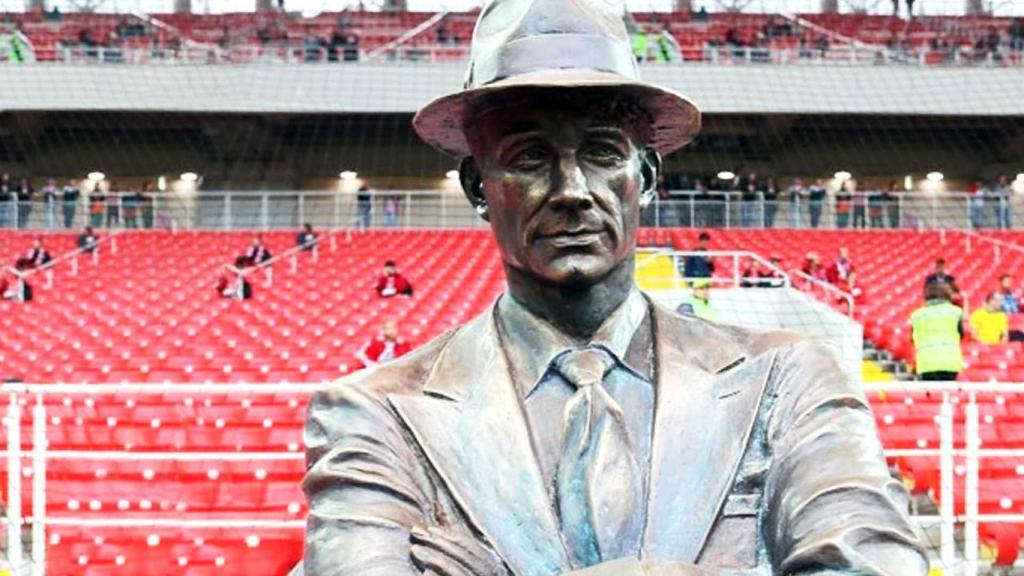
Nikolai Starostin statue on the Moscow Spartak Stadium
The title ‘Kairat’, which suggests “braveness” in Kazakh, was no coincidence. Dinmukhamed Kunayev, then chief of the Soviet Socialist Republic of Kazakhstan, personally influenced his selection, searching for to create Kazakh nationwide symbols inside the Soviet system.
Kunayev would later grow to be the primary Kazakh chosen to the Politburo of the Communist Occasion of the USSR in 1971, changing into a key determine of the Soviet coverage and ally of Leonid Brezhnev.
The development of the Almath Central Stadium additionally has direct political connections: it was Brezhnev himself, then chief of the Kazaja Republic, who started its building in 1956 and personally selected its location.
The architect Adambay Kapanov took as a mannequin the Luzhniki stadium in Moscow, making a smaller model that was nicknamed the ‘Luzhniki’, an emblem of the connection between the capital and the Soviet periphery.
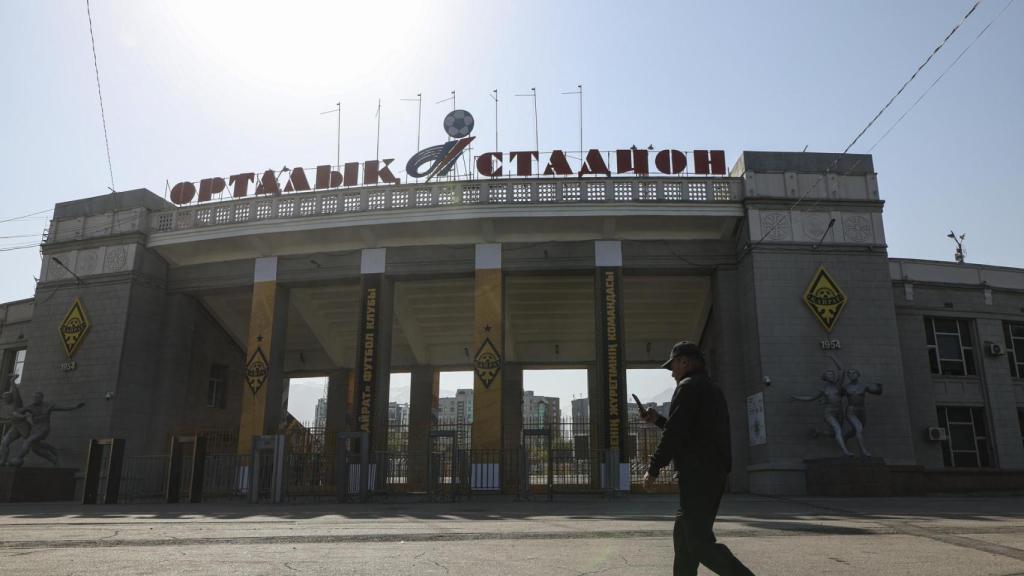
The central stadium of the Kairat Almity, presently
EFE
The Kairat turned the one consultant of Kazakhstan within the Soviet Superior League, remaining 24 seasons within the highest class, a report for a central Asia crew that consecrated it as ‘the crew of the nation’.
His finest historic place was the seventh place in 1986, the 12 months that curiously marked the start of the tip of the Soviet period in Kazakhstan and the start of the occasions that will result in nationwide independence.
The defensive type of the crew through the Soviet period was so attribute that the press and followers baptized him as ‘Kaira’s concrete’, a nickname that lasted a long time and mirrored his extremely -deputy tactical philosophy.
This tactic, though efficient, additionally resulted in offensive weaknesses and a poor scoring fee that restricted its aspirations on the highest degree of Soviet soccer, reflecting the restrictions of an excessively conservative strategy.
A little known achievement is that the Kairat became the first Asian Soviet team to win a European tournament when he defeated Rapid Bucharest in the 1971 final of the European Railway Cup.
The club was part of the USSR voluntary sports societies, organizations linked to specific industries. The Kaira was originally associated with agriculture, reflected in its first shield with wheat crowns.
Zheltqsan, the beginning of independence
In 1986, Mikhail Gorbachev abruptly dismissed Kunayev and replaced him with Gennady Kolbin, a Russian without kazajas roots, a decision perceived as a centralist imposition that ignored the national identity Kazaja cultivated for decades.
Kunayev’s dismissal triggered the ‘December events’ of December 16, 1986, when thousands of young people and students took to the streets of Almaty in the first mass protest against Soviet power.
These riots, known as Zheltqsan in Kazakh, were hard repressed but left a deep mark on national memory, becoming the germ of the nationalist awakening that would culminate in independence in 1991.
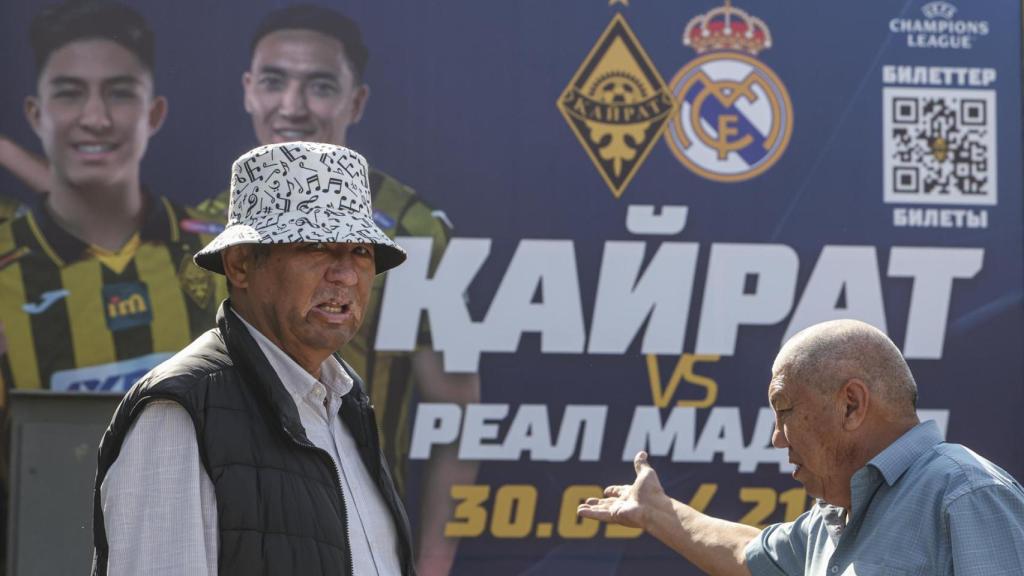
Promotional image of the party between Kaira and Real Madrid in the streets of Almath
EFE
The FC Kaira, as a cultural and sports symbol linked to Kunayev, was involuntarily transformed into a resistance and memory space for the Kazakh people, transcending its purely football function to become a national emblem.
A unique curiosity of the club is the tradition of their fans to carry giant toothbrushes during the matches, a custom that began in the 1970s when they simulated having microphones while singing.
Today, the club is still the only private one in Kazakhstan, owned by businessman Kaira Boranbayev, who has 70% of the actions and maintains a strong ecological awareness derived from the country’s Soviet nuclear past.
The team that will receive Real Madrid this Tuesday includes jewels such as Dastan Satpaev, 17 -year -old striker already signed by Chelsea for four million euros, and Sherkhan Kalmurza, 18 -year -old goalkeeper.
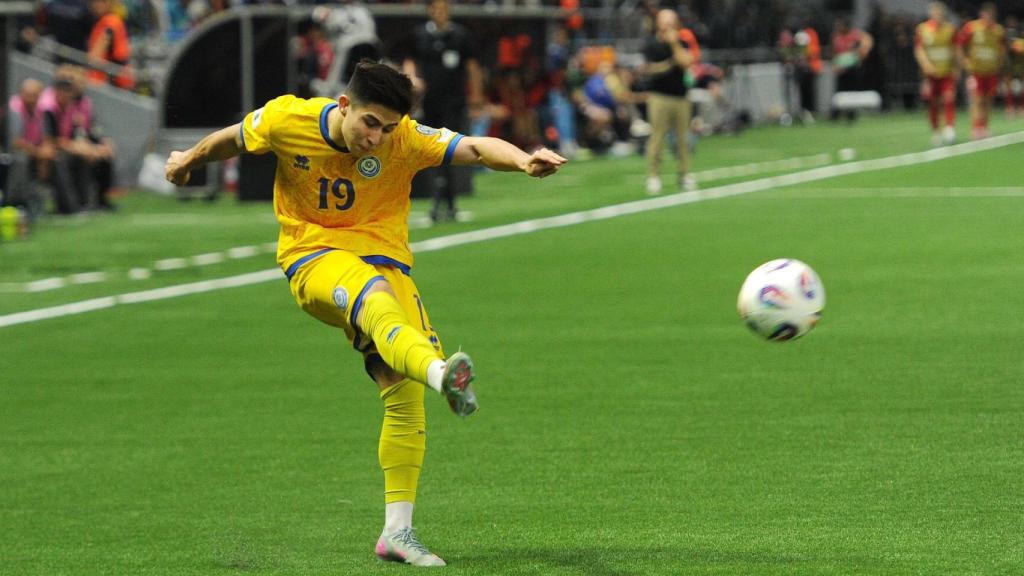
Dastán Satáyev, during a match with the Kaira Almity
EFE
Kaira’s goalkeeper crisis reflects his fighter spirit: Aleksandr Zarutskiy is injured and feared Anarbekov, hero of the classification against Celtic after stopping three penalties, suffers a jaw fracture.
Anarbekov, valued in just 200,000 euros, was the second goalkeeper and only played because Zarutskiy was injured in the head during the first leg against Celtic, unexpectedly becoming a national hero.
The meeting will be played at the Central Stadium that housed the Soviet dreams of Kunayev and Brezhnev, with capacity for 23,804 spectators and located at the foot of the Trans-ili mountain mountain, offering a unique mountainous curtain.
The club only acquired the ownership of the stadium in 2015 in exchange for the Almath Council to obtain a 30% participation in the club, reflecting the complex public-private relations in the modern Kazakhstan.
Xabi Alonso, this Tuesday at the Kairat Almity stadium
EFE
This Champions League match represents much more than a sports confrontation: it is the encounter between European history and Soviet memory, between the present of world football and the past of a missing empire.
When Mbappé, Vinicius or Bellingham step on Almath’s grass, they will also be treading on the story of a club that was a national symbol, resistance testimony and, finally, involuntary precursor to the independence of a nation.
Real Madrid’s trip to east is not only geographical, but temporary: a return to the echoes of Soviet football where the Kairat Almaty remains the guardian of a memory that transcends the 90 minutes of play.


.jpg?w=120&resize=120,86&ssl=1 "Chelsea Players Salaries 2025 (Weekly Wages) – CFC Highest paid 2025/26")


